The Bernina© apple originates from years of research at the University of Bologna, but finds in Valtellina the context in which to fully express its potential. Around this variety, a project has been built involving Fondazione Fojanini, producers and the Lombardy Region, eventually developing into an organised value chain. For the Community Plant Variety Office (CPVO), Bernina© represents a concrete example of how the plant variety protection system can support territorial strategies capable of combining innovation, identity and development.
Not all agricultural innovations are destined to become territorial stories. Many remain confined to the sphere of research. Others find technical application without ever translating into a broader vision. More rarely, a varietal innovation becomes the starting point of a collective path, capable of involving institutions, research and companies along a shared trajectory.
The Bernina© apple belongs to this second category.
For the Community Plant Variety Office (CPVO), the value of this project does not lie solely in the creation of a new variety. It lies in the way a variety is recognised, accompanied and gradually integrated, step by step, into a local development strategy.
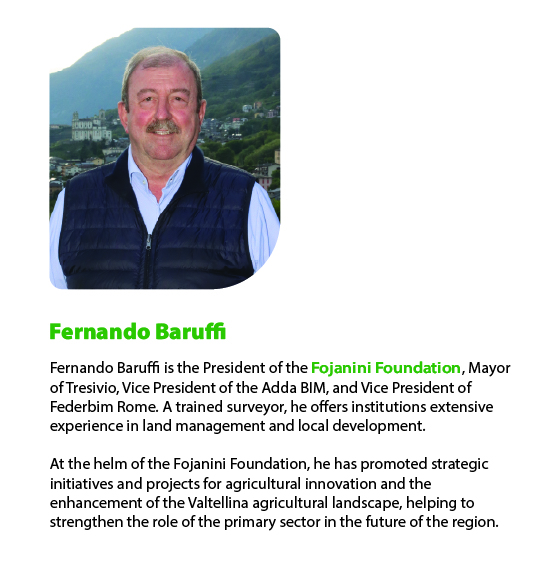
As observed by the President of Fondazione Fojanini, Fernando Baruffi: “For us this project originates from the territory, but becomes an example of collaboration between institutions that then produces concrete effects on local productivity.”
This statement summarises the essence of the journey: not an isolated experiment, but a sequence of decisions that, over time, began to converge.
At the origin is the breeding work carried out by the University of Bologna, developed over an extended period. The selection initially identified as MD03UNIBO — today Bernina© — is the result of this process.
At the same time, Valtellina has for years represented a reference territory for applied experimentation in mountain fruit growing. Here operates Fondazione Fojanini, with a clear mandate: to produce useful technical knowledge and transfer it to the local agricultural fabric.
When the first field trials also involve this territory, a simple but decisive element emerges: among the different varieties observed, one shows behaviour more consistent with the valley conditions.
Not better in an absolute sense. More suited.
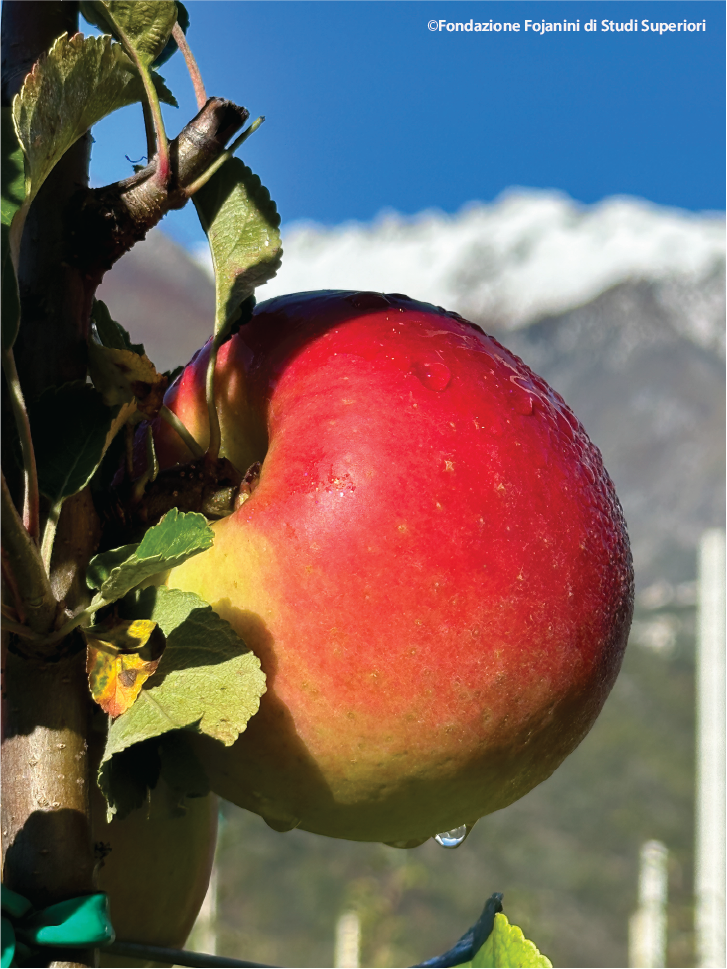
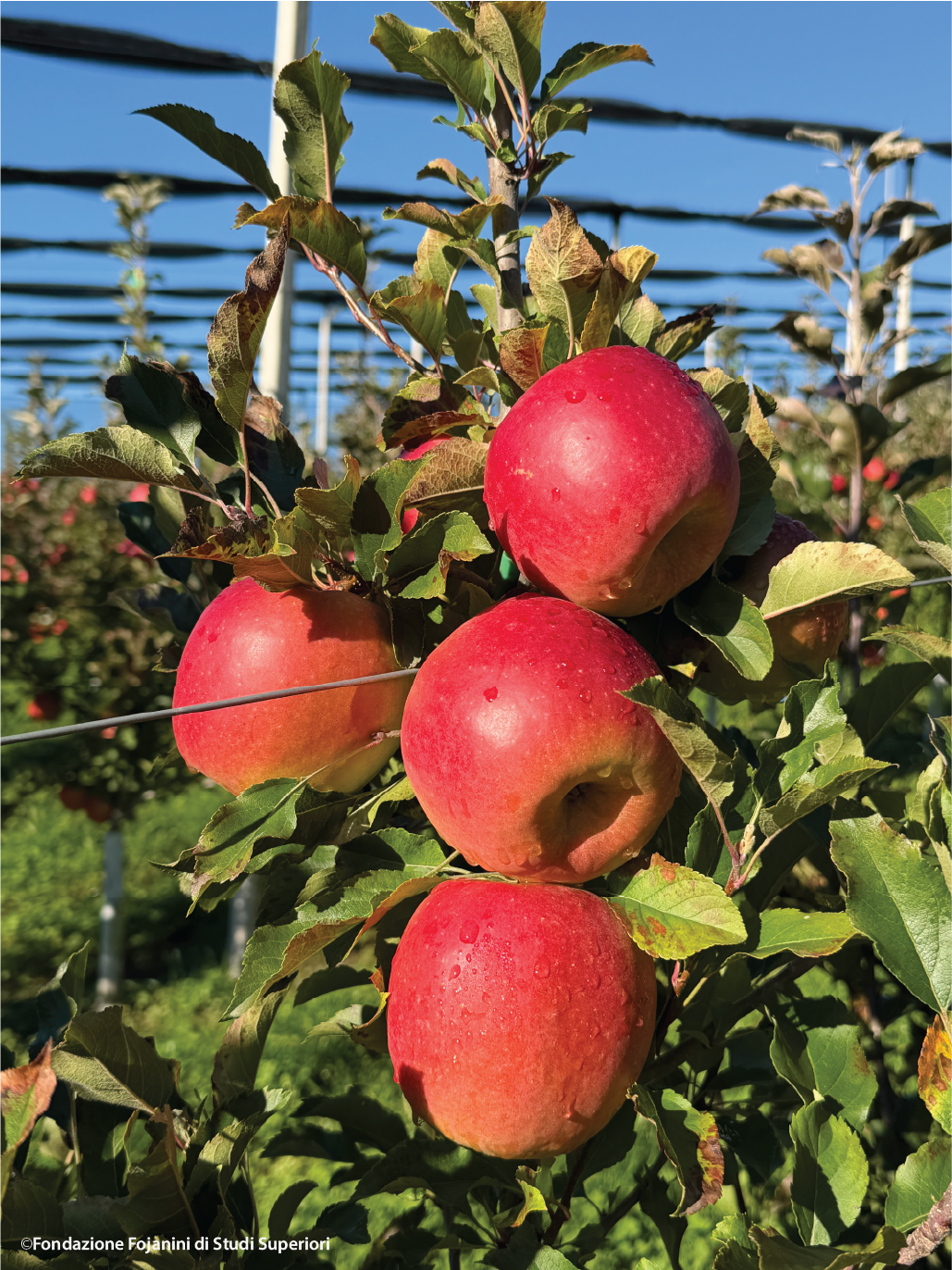
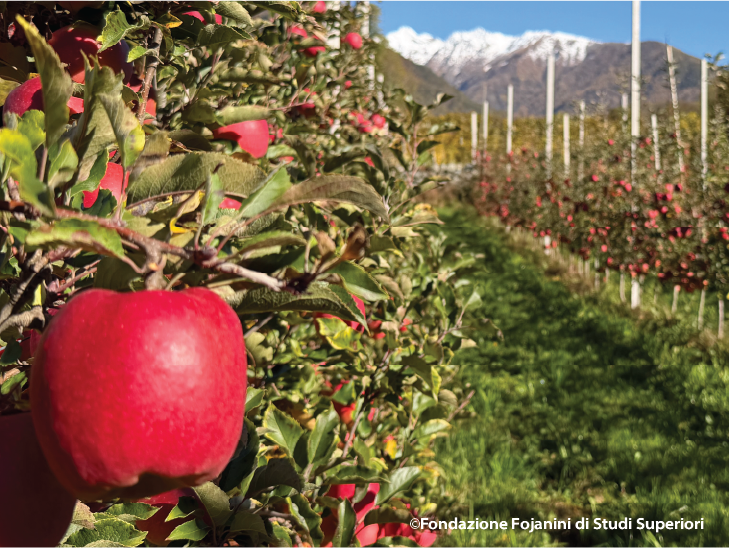
In particular, Bernina© shows an ability to express colour and organoleptic quality with greater intensity at the typical altitudes of the valley. An element which, in a mountain context, takes on strategic value.
It is at this stage that the project makes its first conceptual leap.
It is no longer only a matter of evaluating a new apple. Reflection begins on which variety could become part of the productive identity of the valley.
Fondazione Fojanini, drawing on its knowledge of the territory and on climatic data collected over time through the agrometeorological service and monitoring activities, integrates the observations of the University with a local reading: where to place the variety, in which areas, and with which agronomic practices.
The project thus begins to take on a different profile.
No longer a variety that “could work.”
But a variety that, under certain conditions, demonstrates that it works.
On this basis, the next question arises: if a variety shows distinctive behaviour in Valtellina, does it make sense to imagine for it a specific pathway, built together with producers?
From agronomic data to strategic choice
The technical data, in the case of Bernina©, is not treated as a result to be archived. It is taken as a starting point.
The University of Bologna and Fondazione Fojanini continue the in-depth work: trials in different areas, repeated observations, evaluations on cultivation requirements and responses to environmental conditions.
This work produces something that goes beyond numbers. It produces reliability.
Meanwhile, a structural issue becomes increasingly evident. Fruit growing in Valtellina is going through a complex phase. Pressure on margins, market volatility and climate change place under stress a sector that, for decades, has represented a central component of the local agricultural economy.
In this context, Bernina© begins to be considered not only as an apple that grows well in the valley, but as a possible lever for renewal.
The proposal rests on three elements: fruit quality, a resistance profile allowing more sustainable management, and the possibility of building a close link between variety and territory.
In 2020, Fondazione Fojanini launches the first meetings with the main fruit companies in the province of Sondrio.
These are not promotional presentations. They are moments of technical discussion.
As Baruffi recalls: “When we started discussing it with the companies, we found interest and openness, because there was already serious technical work behind it.”
This step marks the entry of the project into a new phase.
From technical hypothesis to collective hypothesis.
When the public dimension comes into play
The next step concerns scale.
A variety can be tested by a few companies. A territorial project requires an institutional framework.
Fondazione Fojanini presents Bernina© to the Lombardy Region as a proposal based on three pillars: scientific validation, interest from the productive sector, and potential territorial impact.
The Region recognises in the project a concrete response to the needs of the valley and decides to support it through dedicated funding.
Baruffi describes it in simple terms: “When the Region also decides to support it, it means that the project is recognised as a response to the needs of the territory.”
This passage consolidates the trajectory of the project.
University, Foundation, companies and regional institutions begin to move within a shared framework.
From project to value chain
As the dissemination phase approaches, the challenges change in nature.
They no longer concern cultivation alone. They concern organisation.
Fondazione Fojanini chooses to assume the role of Managing Entity of an experimental value chain dedicated to the Bernina© apple in Valtellina.
This means coordinating the different actors, defining a common production protocol, establishing quality criteria and supporting promotional activities.
As Baruffi summarises: “This led us to take on a role that goes beyond the technical-scientific dimension: coordinating different actors and defining common rules.”
Bernina© definitively ceases to be a sum of orchards.
It becomes a system.
Protection as project infrastructure
At the moment when a variety enters a value-chain logic, protection becomes an operational element.
Variety protection and trademark are conceived as tools to guarantee coherence, avoid fragmentation and protect investments.
Baruffi observes: “We are the ones who then have to present the project to farmers. Knowing that there is a clear protection structure behind it makes us feel more confident.”
For the CPVO, this step is central: protection is not an end, but an enabling condition.
Bernina© as a tool for territorial stewardship
Bernina© is progressively also interpreted as a stewardship tool.
Fruit growing contributes significantly to shaping the Valtellina landscape. Maintaining cultivated areas means preserving environmental structures, infrastructure and expertise.
Baruffi summarises it as follows: “The agricultural landscape is a peculiarity of Valtellina and it is essential to preserve it.”
A side effect: building trust
Over time, the project has created structured opportunities for discussion between companies.
As Baruffi notes: “For the first time we managed to bring the main entrepreneurs of the valley around the same table.”
This result, not initially planned, becomes one of the most valuable elements of the project.
A pilot project
Bernina© is considered a pilot project because it covers the entire chain: from varietal selection to commercialisation.
It is not an exception.
It is a reference.
The most complex phase lies ahead
The project is now entering the most demanding phase: expansion of surfaces, consolidation of volumes, stabilisation of the value chain.
But the path built has already produced a key result: demonstrating that a trajectory is possible.
Why this story matters
For the CPVO, Bernina© is not important because it is a successful apple.
It is important because it shows how the plant variety protection system can fit into concrete territorial strategies, contributing to the construction of development that is rooted, sustainable and coherent with local specificities.
In this sense, Bernina© is not only an apple.
It is a project.