
From the lecture halls of the Alma Mater to the peaks of Valtellina, the story of a genetic success story that merges science, legal stewardship, and a passion for the land. A model of innovation where the University of Bologna takes center stage in the European fruit-growing landscape.
Innovation in the agricultural sector is not an immediate process, but the result of an institutional vision capable of protecting and leveraging investments in public research. The system of Community Plant Variety Rights (CPVR—a sui generis intellectual property right for protecting new plant varieties) and the combination of Intellectual Property (IP) rights do not represent a mere bureaucratic constraint, but rather the essential tool to ensure that scientific progress actually reaches the market. The case of the Bernina© apple—and its "sister" Dora©—exemplifies how collaboration between the University of Bologna and public and private partners can transform years of genetic study into concrete economic and identity-driven value.
From managing thousands of seedlings to conquering international markets: how the University of Bologna transforms genetics into a territorial and commercial asset through a sophisticated Intellectual Property strategy.
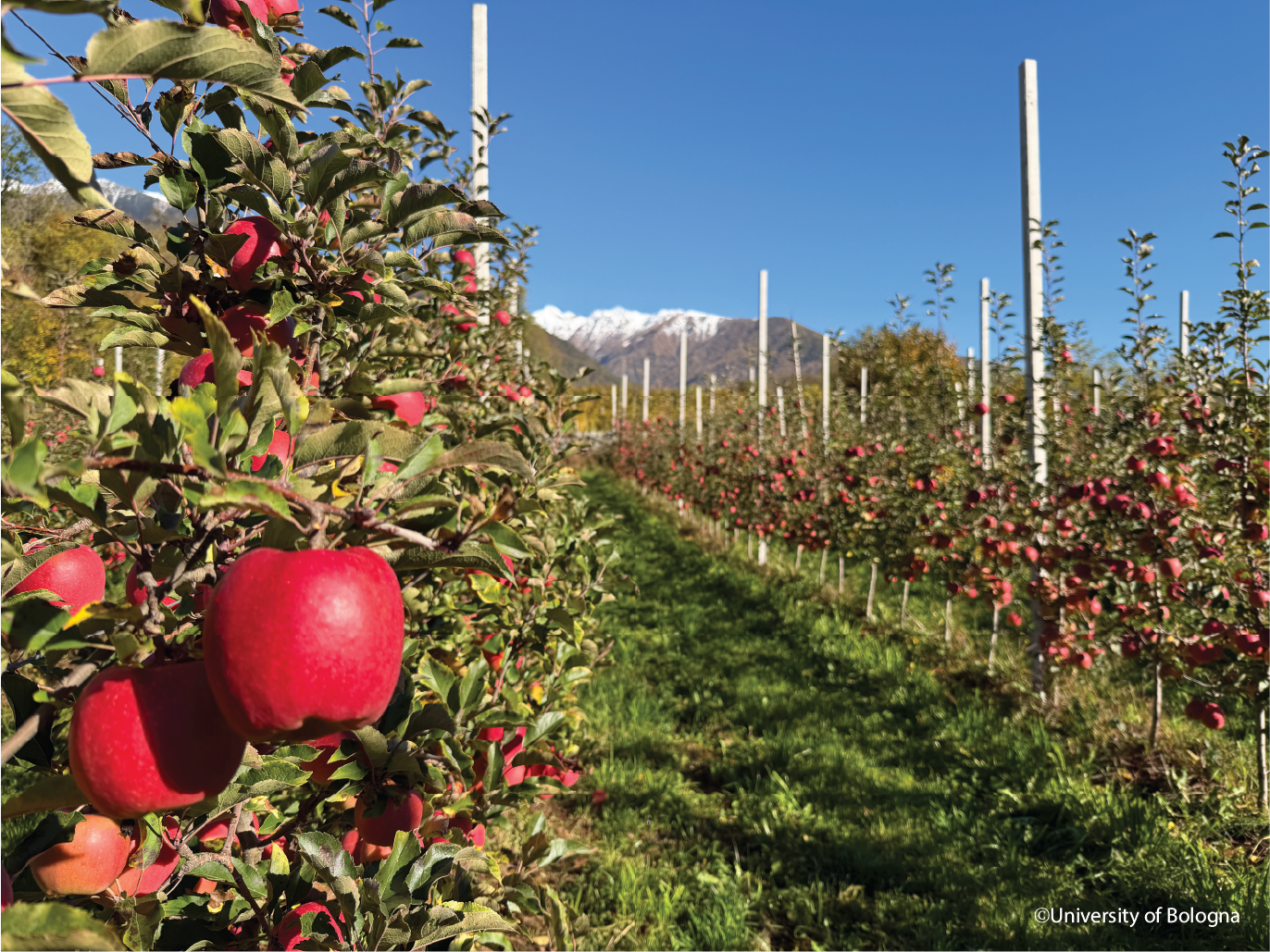
The Breeding Process (Genetic Improvement): Twenty-Five Years of Rigor and "Genetic Patience"
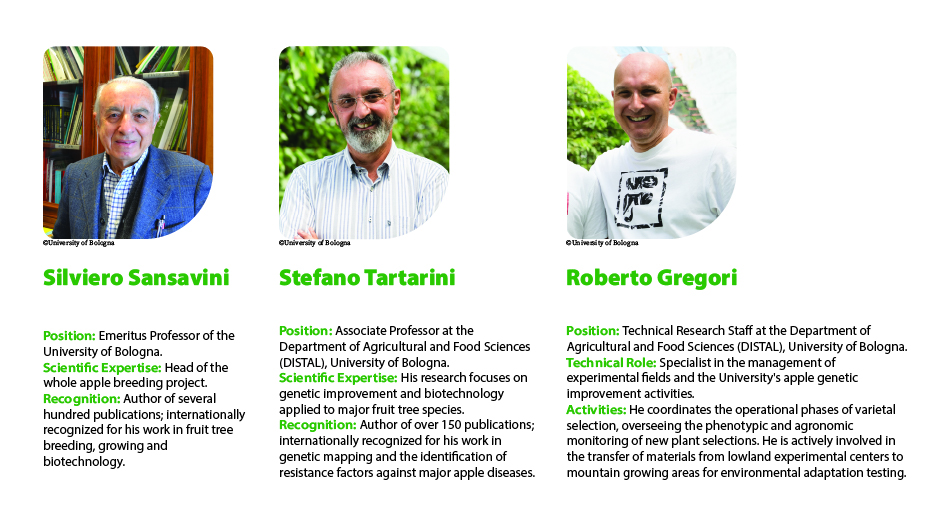
The path that led to the birth of Bernina was not a straight line, but an exercise in scientific patience led by Professor Silviero Sansavini and the research team at the Department of Agricultural and Food Sciences (DISTAL).
The breeding process was structured through extremely rigorous phases:
- The specific cross: Everything started at the end of the 1990s with a cross between Cripps Pink© and Primiera©.
- The mass critical scale: The University managed massive numbers: a total number of about 60,000 seedlings from many controlled crosses
- Phenotypic selection: The process of identifying physical and observable traits, where each plant was observed for years.
Although the specific cross that gave life to Bernina© is much more recent (dating back to the end of the 1990s), this apple is the mature fruit of a journey that began in the 1970s with the vision of Professor Sansavini. Over the years, he collected more than 2,000 apple accessions (samples of genetic material from a specific location or variety) from all over the world at the Alma Mater, creating a fundamental base for studying the genetics of numerous plant and fruit characteristics.
The University managed staggering numbers: approximately 60,000 seedlings were planted and evaluated. "Everything started from the availability of a vast apple genetic heritage that gave us the possibility to obtain some innovative varieties that are now new inventions," explains Roberto Gregori.
This was not research for the elite few: the breeding program managed an impressive critical mass. "It was born because in the past... there had been an interest in genetic improvement... a very large catalog field (a reference collection of varieties) had been established... it was necessary because obviously having a very broad genetic heritage gives the possibility of being able to obtain varieties that are now new inventions," Gregori continues.
"The process of genetic improvement... is not: Today I think of it, and the result arrives tomorrow. The process of improvement is: today I think of it, but the certain result belongs to a distant tomorrow. A tomorrow that can mean twenty years," adds Gregori.
While private programs often accelerate the process, the University prioritized "in-depth evaluation," observing the behavior of the best selections in different environments and testing their post-harvest shelf life. "Farmers who, for example, invest in Bernina today, cannot find themselves facing surprises in a few years," explains Stefano Tartarini. "They need to have guarantees to limit the risks on their investment. This is the added value of the University."
A determining step for the consolidation of Bernina© was its preliminary evaluation within the ministerial project “Liste di orientamento varietale” (Varietal Orientation Lists). This project acted as a bridge between the excellence of international varietal innovation and the real needs of the agricultural world.
This evaluation mechanism was a rigorous testing ground: "Since 2012, the variety has been included in this circuit of trials managed centrally, where it was tested in different Italian areas, from Piedmont to Friuli-Venezia Giulia, down to Sicily," explains Roberto Gregori. Through this project, independent evaluating bodies provided the Ministry—and consequently the farmers—with a guarantee of reliability, certifying that the varieties and selections were not just a novelty, but a solid agronomic innovation ready to be successfully cultivated.
This institutional synergy transforms the breeder's work into a shared public value. When the University nominates a selection like MD03UNIBO* for the varietal lists, it activates a technical dialogue involving testing centers and trade associations, ensuring that the investment made in public research has a direct and secure impact on the territory. For farmers, consulting the varietal lists meant being able to choose the University of Bologna's innovation with the certainty of an independent evaluation, reducing business risks and favoring the varietal renewal necessary to keep Italian and European fruit growing competitive.
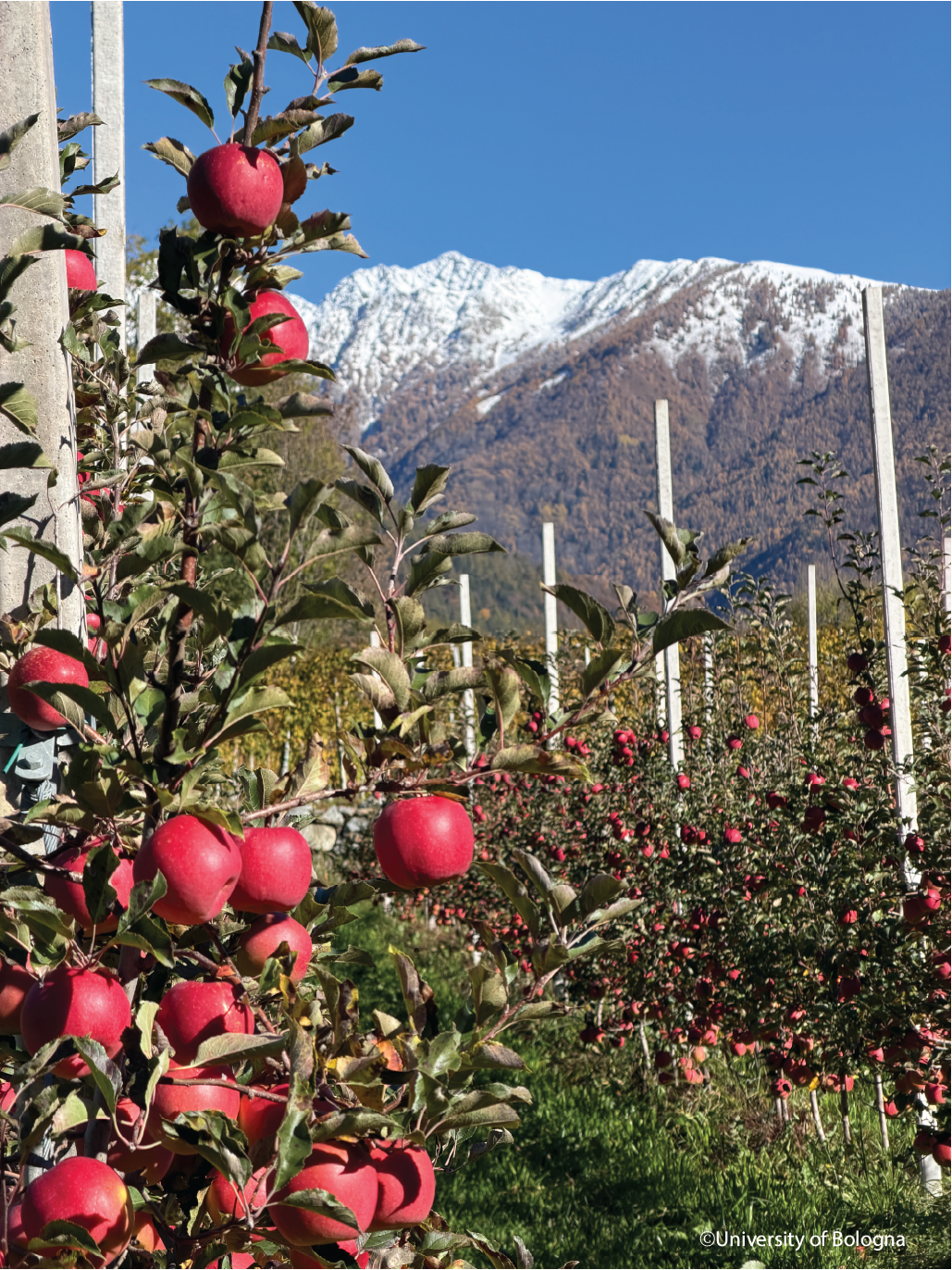
The environmental "relocation": "In the plains, this apple was good but not particularly attractive... in Valtellina, it showed its true potential," notes Roberto Gregori.
Data as insurance: During the decade of scarce funding (2010-2015), the work did not stop. The continuity in data collection allowed for the arrival today of a "stable" and tested variety, reducing risks for those who decide to plant it today.
Research as a Pedagogical Workshop: The Role of Students
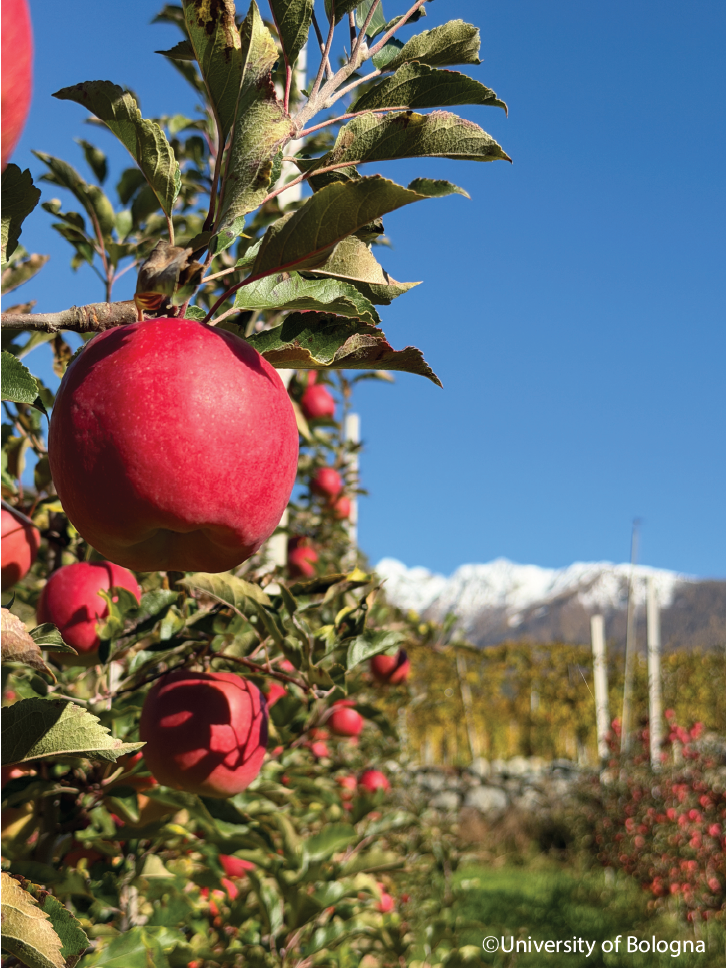
Beyond its agronomic and commercial value, the breeding project that led to Bernina fulfilled an irreplaceable academic function, transforming into an open-air laboratory for dozens of Alma Mater students. "There was a whole collateral activity... the populations we managed served for graduation theses, doctoral theses, and important publications," highlights Stefano Tartarini. This approach allowed students to deal with real-world cases, analyzing thousands of seedlings and learning the complexity of varietal selection in the field.
A World Record: The Bridge Between ‘PNAS’ and University Classrooms
The rigor of the University of Bologna's research process has led to milestones that exceed the boundaries of agronomy. Professor Stefano Tartarini emphasizes a fundamental passage that confers global scientific authority on the project: the work carried out on these genetic populations allowed the Bologna team, in collaboration with the Politecnico di Zurigo (ETH Zurich), to be the first in the world, in 2004, to publish the sequence of a resistance gene to a fungal disease in a fruit plant.
This discovery was published in 2004 by the Proceedings of the National Academy of Sciences USA (PNAS), one of the most prestigious scientific journals in the world. "It was the first resistance gene identified in a fruit plant," recalls Tartarini. This first discovery was the beginning of intense teaching and research activity. The genetic improvement program from which Bernina© was born allowed Alma Mater students to engage with a cutting-edge project through the writing of several graduation and doctoral theses. The "simple" act of creating an apple led to an important educational and scientific contribution.
The Licensing Strategy: The "Unibo Model" for the Market
Once a valid variety is obtained, the challenge moves from the field to the offices of the Knowledge Transfer Office (KTO), where the University of Bologna has structured a licensing strategy that balances economic returns and social impact.
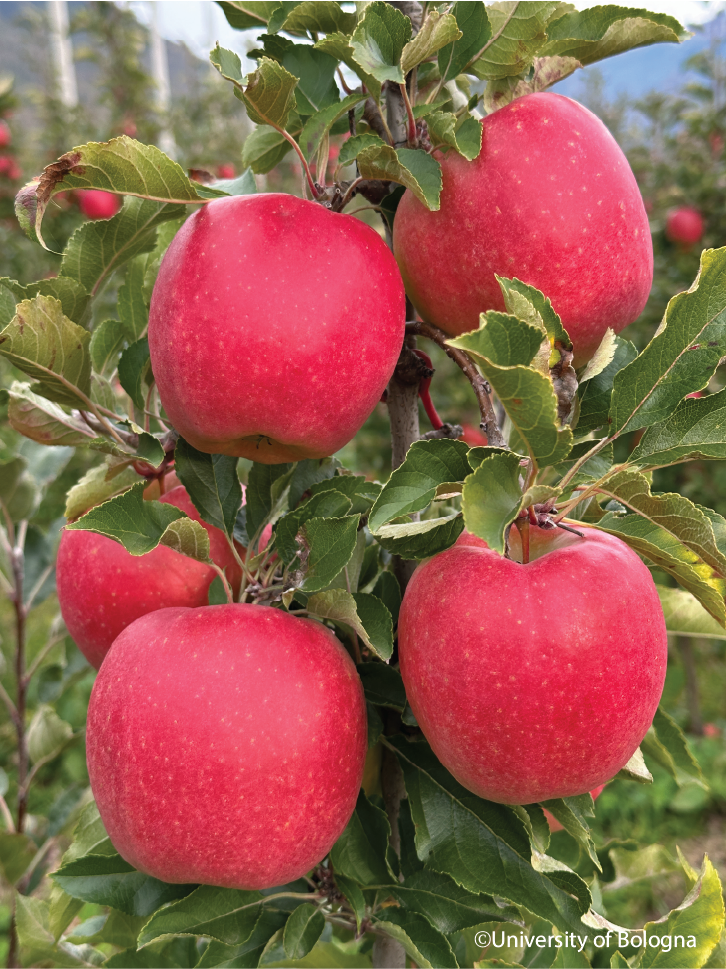
While researchers like Gregori and Tartarini deal with the soil and genes, the professionals working at the KTO act to build the legal and "commercial" armor of the project. Andrea Ravaioli describes the KTO as a bridge: protection through plant variety rights is not an end, but the means to allow the private sector to invest. "Without protection," Ravaioli explains in the conversation, "research risks remaining locked in laboratories." The strategy built around Bernina was surgical: the trademark and ownership of the variety rights remain with the University to ensure control and protection of the variety in close collaboration with partners; but the choice to root the project in Valtellina transformed a simple license agreement into a journey of territorial development and safeguard.
For Andrea Ravaioli, the protection of intellectual property is not an act of closure, but the indispensable engine for technology transfer toward society. His reasoning starts from a pragmatic premise: an academic invention, however brilliant, risks being confined to laboratories if it is not legally "armed." The plant variety right (CPVR) acts as a guarantee for the industrial partner, offering the certainty of an exclusivity that justifies the massive investments necessary to bring the apple to the shelves. As highlighted by Ravaioli, protection is the fundamental tool to increase the chances of seeing the results of public research valued through private dynamics, which are the only ones capable of managing large-scale distribution.
The sophistication of the University of Bologna's strategy emerges in the separate management of the trademark compared to the variety right. While the latter protects genetic innovation for a limited time, the "Bernina©" trademark represents an asset owned by the University that allows perpetual control over the product's identity. The reasoning is clear: the commercial name is not just a label, but a piece of the road traveled together with the territorial partner to build a coherent narrative and product image. By maintaining ownership of the trademark and the variety right, the University reserves the power to ensure the apple is marketed respecting the quality and value standards the institution represents, intervening if management should deviate from the original mission.
Finally, Ravaioli's discourse highlights how the combination of these IP tools serves to protect the reputation of the Alma Mater and ensure an ethical return on research. The licensing strategy requires that the link with the University of Bologna never be obscured, with the aim of highlighting the role of the University and the importance of public research, preserving its integrity, and providing partners with a recognizable guarantee of transparency and scientific solidity. This model creates a virtuous circle: the royalties generated do not feed profits for their own sake, but are reinvested in the University to fund new research. In this light, intellectual property becomes a tool capable of making public research increasingly self-sustainable, ensuring that today's success funds tomorrow's discoveries.
- Territorial and Social Exclusivity: For Bernina©, the University chose a "European license" for the Valtellina territory via the Fondazione Fojanini. It was not just a commercial choice, but a political and institutional one: "If I can bring good to and save an Italian valley that lives on apple growing, the element of the public institution truly shines through," says Andrea Ravaioli.
- Trademark Control: The University remains the owner of the "Bernina©" trademark. This means the licensee can use the name to sell the product but must respect quality standards and always mention the academic origin. "We collaborate... to ensure that they don't forget to mention that the variety was born from the University of Bologna, an element that is sometimes used by partners even as a marketing tool," notes Andrea Ravaioli.
- Diversification (The Case of Dora©): Regarding the management of apple varieties, Professor Stefano Tartarini mentions the collaboration with a major French nursery group for the Dora© variety. While the Bernina© apple was conceived as an asset for the territorial relaunch of Valtellina, the Dora© variety follows a different market logic, oriented toward a specific niche of consumers who appreciate so-called "russet" apples (apples with rough, brownish-green skin). The strategy adopted with the French group is an exclusive European license, allowing the Dora© variety to be cultivated and marketed for now in France and later in the rest of Europe. This agreement demonstrates the University's ability to differentiate its business models: if for the Bernina© apple an exclusive territorial license was chosen to support a local mountain economy, for Dora© the focus was on an international player capable of valuing the organoleptic characteristics (properties perceived by the sense organs, like taste and smell) of the fruit on a wider market. This relationship also serves to generate a flow of royalties for the University, allowing for the funding of new programs and research fellowships (assegni di ricerca), which, in the future, will lead to the selection of further innovative varieties.
Technical Aspects: DUS and International Protection
The legal path of Bernina© is currently under the lens of the CPVO (Community Plant Variety Office) for DUS tests:
- Distinctness: The apple must be clearly different from any other existing variety.
- Uniformity: All plants of the variety must exhibit the same characteristics.
- Stability: These characteristics must remain unchanged after each propagation cycle.
These tests are fundamental because, as emphasized in the interview, although genetics may evolve over time leading to the birth of "clones" or mutations, current protection provides the legal basis to act against counterfeiting or unauthorized use.
Research as a Protected Common Good: Toward New Horizons
The parabola of the Bernina© apple, from the laboratories of the Alma Mater to the orchards of Valtellina, demonstrates that innovation is not an isolated event, but an ecosystem fueled by rigor and protection. The success of this project is measured not only in the prestige of publications in outlets like PNAS, but also in the international recognition of the University's role in apple genomics, and above all, in the ability to transform that pure science into a tool of resilience for rural communities. For the University of Bologna, having raised generations of students within such an advanced breeding program means having sown skills that will continue to sprout far beyond a single variety.
The "Bernina© Model" has traced a clear path for the future: the protection of intellectual property, through the strategic use of variety rights and trademarks, is not an end but a means to favor the valuation of public research. While the Dora© variety begins to conquer international markets thanks to collaboration with French partners, generating the royalties necessary to fund the next scientific challenges, Bernina© remains the symbol of a promise kept toward the Italian territory. It is the demonstration that when academic vision meets far-sighted legal management and authentic agricultural passion, research can truly "contribute to supporting the relaunch of a territory."
The profound meaning of this twenty-five-year journey finds its ideal synthesis in the words of Roberto Gregori, reflecting the pride of an entire institution:
“It is already a victory to have succeeded in promoting and giving our apple to be managed in Valtellina to save the valley’s apple farming... the pride of the university for having tried to spread a variety in an environment that was not ours, finally seeing that work of years translate into a value that remains with the people and the land.”
The Protagonists
Andrea Ravaioli
- Position: Head of the Knowledge Transfer Office (KTO) – Knowledge Valorization Unit, Innovation Area (ARIN), University of Bologna.
- Strategic Expertise: Expert in innovation policy and Intellectual Property (IP) management.
- Role: He coordinates the protection and valorization of the University's research results. He manages the patent and plant variety portfolio, defining licensing strategies and negotiating with industrial partners to ensure that academic innovations generate both economic and social impact.
Simona Cavalleri
- Position: Knowledge Transfer Manager at the Knowledge Transfer Office (KTO), Innovation Area (ARIN), University of Bologna.
- Role: Specialist in the protection and valorization of research results.
- Activities: She supports the commercial and social valorization of research outcomes and manages institutional relations with licensees, facilitating the transition of technologies and new varieties from the laboratory to the market.
Bettina Riedel
- Position: Knowledge Transfer Manager at the Knowledge Transfer Office (KTO), Innovation Area (ARIN), University of Bologna.
- Role: Specialist in the protection and valorization of research results.
- Activities: She handles the procedural and administrative aspects of filing and maintaining industrial property titles (patents, trademarks, and plant variety rights), liaising with national and international patent offices to safeguard the University’s assets.