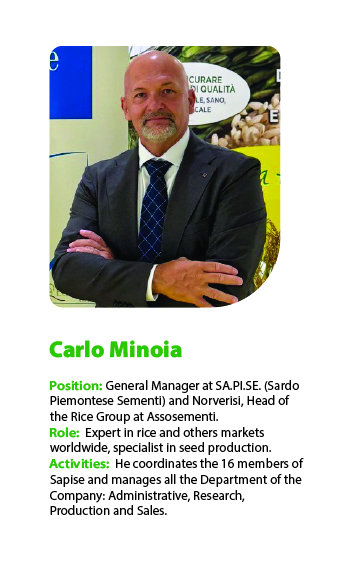

Interviewee: Dr Carlo Minoia
Strategic Vision: Bridging Field and Table
The guiding logic of SAPISE is dual-focused.
Dr Minoia explains that genetic research must never lose sight of its purpose: producing high-performing seed “in service of rice cultivation.” At the same time, industrial logic dictates that agronomic performance alone is insufficient if it is not matched by excellence in “organoleptic quality aspects” for the final consumer.
Structure and Risk: A Geographic Insight
Why a cooperative divided between Piedmont and Sardinia?
Minoia traces the logic back to the founders in 1978. Their “far-sighted, almost textbook” intuition was that the Sardinian microclimate naturally ensured “decisively healthier seed,” with fewer disease issues.
Forming a cooperative was the rational strategy to “enhance the value” of this high-quality seed—producing it on the island and selling it “on the mainland,” the core of consumption and cultivation.

From Seed to System: The Lesson of Riso Venere
How can a variety become an industrial model?
Minoia’s reasoning is market-based: “if I have a variety that performs well in terms of yield but there is no agro-industrial interest, my variety will never break through.”
Riso Venere illustrates this clearly. Registered in 1996, it remained “in the drawer” for years because it was not appreciated—neither agronomically nor organoleptically—by a traditional market. It became successful only when the food industry began to promote it as an alternative, whole-grain product.
The closed supply chain ensures control. The reasoning is both sanitary and qualitative: imposing a strict “supply chain protocol” (reintroducing the 1990s “no input” method) means using chemical treatments only when strictly necessary to prevent greater harm to human nutrition, such as mycotoxins.
The closed supply chain is the only true “guarantee to the consumer” of process integrity.

Economic Value and Redistribution: The Cooperative Logic
How does innovation return value to those who produce it?
Minoia explains that the cooperative system is structurally meritocratic and “based on the contribution of each individual member.” The logic is linear: the cooperative sells on the European market, but the return for each member depends exclusively on the quality of the product delivered.
If seed does not meet standards, “this penalises the member,” compelling them—out of pure economic interest—to “work well.”
Certified Seed: Defending Investment
On genetic piracy, the company’s reasoning is uncompromising. A lack of control over propagation material would be “devastating.”
For this reason, there is an “absolute prohibition” on sending genetic lines to countries without legal recognition. The company knows that third parties could distribute the variety beyond any control, causing “economic damage” and benefiting freely from years of investment made by the Cooperative—investments that would be lost if intellectual property rights could not be enforced.
Bargaining Power and Partnerships: Exclusivity as Protection
The example of Uruguay illustrates this approach. Minoia explains that the strategy relies on local institutions. The Uruguayan national institute coordinates research and has “every interest in monitoring” the development of the registered variety, ensuring for the Italian company “the certainty that there is an entity exercising oversight.”
The Sustainability Differential
In a saturated market, how is competitive advantage built? Through anticipation.
Minoia explains that the company “decided to take a further step forward” by abandoning its previous certification and certifying the entire organisation under the stringent SRP method.
The commercial logic is clear: by offering a demonstrably sustainable product, the company differentiates itself and provides the agro-industry with a sustainability label that few others in Europe can guarantee.