

Developed by NEIKER for the crisps industry, the purple-skinned variety combines distinctive flesh, frying quality, antioxidant compounds and resistance to two major potato diseases.
Breeding a new potato variety is an exercise in balance. A promising clone may perform well in the field but fail during processing. Another may have an attractive appearance but lack the yield, stability or disease resistance required by farmers and industry.
Atsegiñe was selected because it brings several of these characteristics together. Developed by NEIKER over seven years of crossing, evaluation and field trials, the variety has purple skin and purple-and-white flesh. It is intended primarily for the crisps industry, where dry matter content, reducing sugars and colour retention are essential technical considerations.
NEIKER announced the new variety in May 2026, highlighting its suitability for frying, its stable natural colour, antioxidant content and resistance to late blight and Potato Virus Y.
In this interview, the NEIKER team discusses the breeding process behind Atsegiñe, the challenge of combining multiple traits in a single variety and the role that plant variety protection can play in moving publicly funded research towards commercial use.
Combining appearance, quality and field performance
Could you briefly introduce the new bi-colour potato variety developed by NEIKER and explain what makes it different from existing varieties on the market?
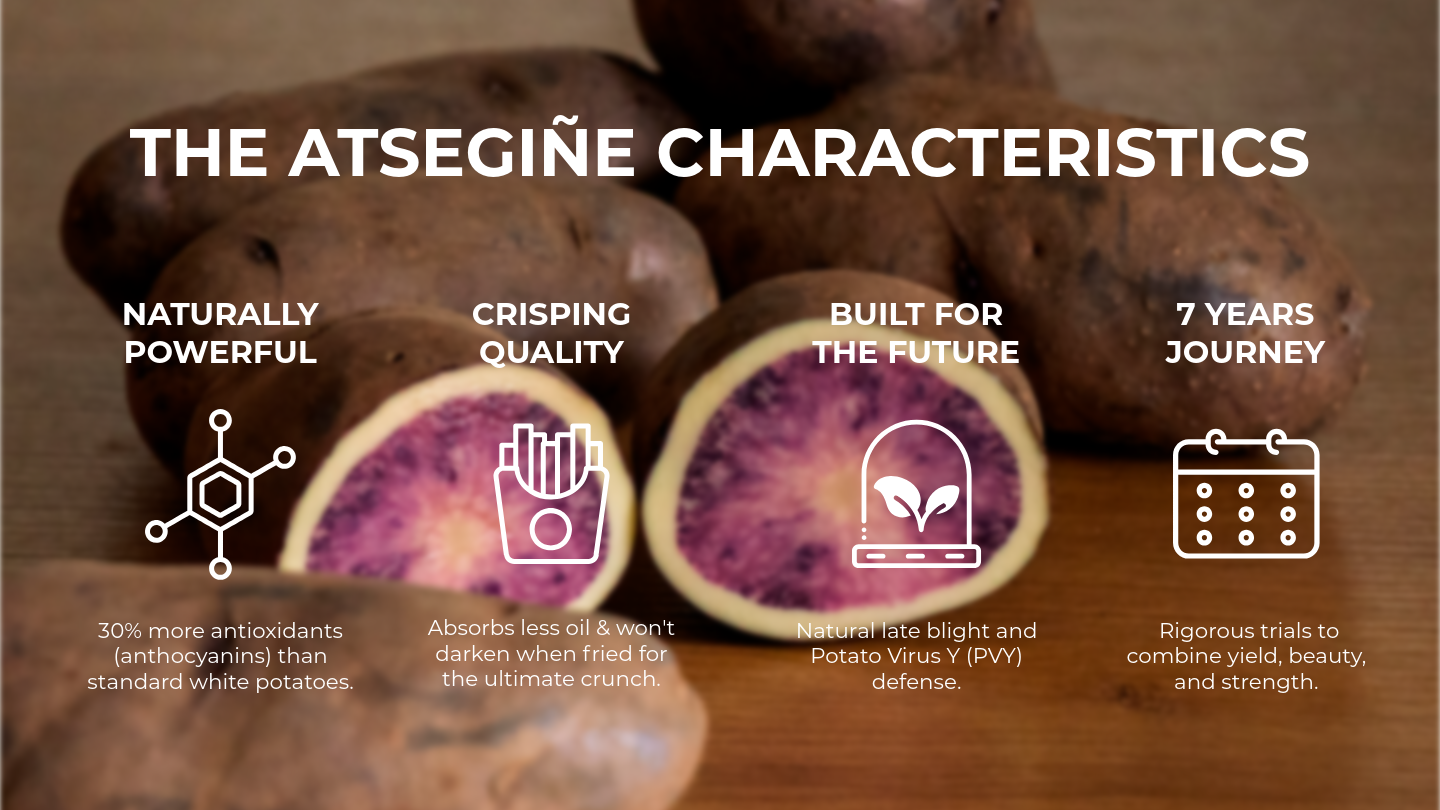
Atsegiñe has characteristics that make it a very interesting variety for agriculture and industry. It is a bicolour potato with a high content of antioxidant compounds, which are beneficial for health. It is also well suited for frying due to its high dry matter content and distinctive flesh, making it attractive for coloured crisps and home frying. Finally, it is highly resistant to late blight and Potato Virus Y (PVY), helping reduce the use of fungicides and insecticides.
From a breeder's perspective, what was the most difficult trait to stabilise: the colour pattern, the frying quality, the agronomic performance, or the combination of all three?
Clearly, it was the combination of all three. Over the seven years required to develop Atsegiñe, the breeding programme evaluated tuber appearance, yield, dry matter content, antioxidant content, suitability for boiling and frying, disease resistance and overall agronomic performance. Many promising clones were discarded because they failed to meet all the desired characteristics.
The development process reportedly took seven years. Could you walk us through the main stages of the breeding process?
The process begins with manual crosses between two parent varieties—in this case, a white and a purple potato. Over the following five to six years, breeders evaluate the offspring for yield, dry matter, antioxidant content, cooking and frying quality, disease resistance, tuber appearance and plant health. Clones that fail to meet the required standards are discarded. The final stage consists of comparative trials across different locations to assess stability under diverse growing conditions.
From the field to the frying line
For the processing industry, appearance is only part of the equation. The composition of the tuber determines how it behaves during cutting, heating and frying, how much oil it absorbs and whether its colour remains attractive in the finished product.
Which technical characteristics make a potato suitable for industrial frying, and how does Atsegiñe meet those requirements?
Atsegiñe combines high dry matter content with low reducing sugar levels, allowing it to absorb less oil and avoid excessive browning during frying. Its bi-coloured flesh also creates visually distinctive crisps that appeal to both industry and consumers.
Its natural colour remains stable after frying or cooking. Why is this technically challenging?
The variety's naturally low reducing sugar content prevents excessive darkening during frying, which is essential for maintaining its attractive appearance. However, like all potato varieties, storage below 7°C increases reducing sugars and can lead to darker chips after frying.
Understanding the nutritional profile
Atsegiñe's purple colour comes from anthocyanins. Compared with traditional white-fleshed potatoes, the variety contains higher levels of antioxidant compounds, although these compositional differences should not be interpreted as medical claims.
How should consumers understand Atsegiñe's nutritional profile?
Compared with traditional white-fleshed potatoes, Atsegiñe contains around 30% more antioxidant compounds. These originate from anthocyanins, the pigments responsible for its purple colour.
Resistance as a tool for more sustainable production
Disease resistance influences more than crop yields. It can reduce pesticide use, lower production costs, improve seed quality and contribute to more sustainable farming systems.
How important are resistance to late blight and Potato Virus Y for farmers?
Resistance to late blight reduces the need for fungicide applications, benefiting both farmers and the environment. High resistance to Potato Virus Y also reduces insecticide use by limiting the need to control aphids, the virus vectors. Together, these traits lower production costs while supporting more sustainable cultivation.
Protecting the results of public research
Developing a new variety requires years of scientific work, field testing and investment. Plant variety protection helps publicly funded research organisations license their innovations, collaborate with commercial partners and reinvest revenues into future breeding programmes.
Why is plant variety protection important for a publicly funded research centre?
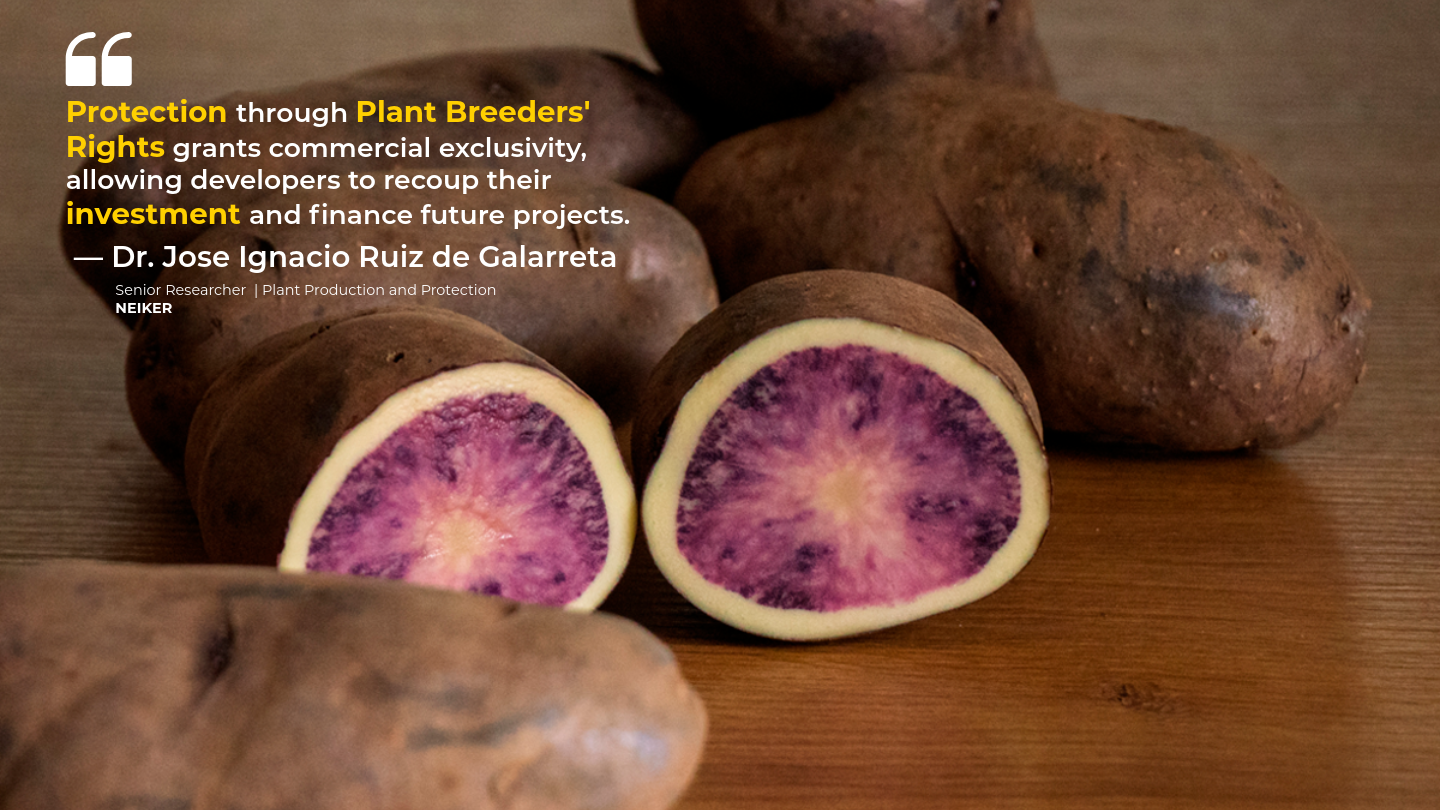
Developing improved varieties can take more than a decade. Plant Breeders' Rights provide commercial exclusivity, allowing breeders to recover investments and finance future research. Registration also enables the use of a phytosanitary passport, helping guarantee high-quality seed, prevent fraud and reduce the spread of harmful pests and diseases.
How does the Community Plant Variety Rights system help move a variety from research into practical use?
For seed producers, farmers and processors, registration and protection provide confidence that the variety meets strict quality and phytosanitary standards while ensuring a reliable supply of certified planting material.
Genetic diversity: the starting point for future varieties
Atsegiñe illustrates why breeders depend on access to diverse genetic resources. Germplasm collections preserve valuable traits that can be combined to develop future varieties.
What role does genetic diversity play in developing new varieties?
Genetic diversity is the foundation of plant breeding. Germplasm collections act as living libraries, allowing breeders to identify and combine valuable genes to develop varieties with improved agronomic performance, nutritional quality and visual appeal.
The next stage: licensing and commercial uptake
Registration is not the end of the breeding process. A new variety must still enter seed multiplication, commercial production and industrial processing through partnerships with seed producers and food companies.
What are the next steps for Atsegiñe?
The variety has recently been registered and is now being promoted. Several processing companies and seed producers have already expressed interest, and the next step is to develop commercial partnerships and licensing agreements.