From genetic selection to the creation of a territorial value chain: the Bernina© project shows how a new variety can become a tool for local development when research, institutions and operators work along a shared path.
Uta Biino, Technical Director at ERSAF Lombardy, “Regional Agency for Agriculture and Forestry Services”, coordinated the project for building the new apple value chain in the Valtellina area. Within ERSAF, she oversees and coordinates, among other activities, initiatives related to alternative agricultural value chains and the development of projects that integrate technical experimentation, economic planning and territorial enhancement, with particular attention to applied innovation in agriculture and the adaptation of agroecosystems to climate change, in collaboration with universities, research centres and local authorities.
ERSAF is the instrumental body of the Region of Lombardy supporting regional policies in agriculture, forestry and rural development. Through technical assistance, experimentation, project design and coordination of interventions, the agency helps territories and value chains translate public policies into operational actions. Its role lies at the intersection between regional policy guidance, technical expertise and the concrete needs of the Lombard agricultural system.
In 2021, the Region of Lombardy entrusted ERSAF with the implementation of the project “Field experimentation on the economic and environmental suitability of the new apple variety provisionally named ‘Mela Rosata’, aimed at establishing a production value chain in Valtellina”, a five-year project with a regional contribution of €600,000.
The project included field trials, economic assessments, brand identification, selection of a managing entity for value chain development, purchase of an option during the experimentation phase, and acquisition of the licence for cultivation and marketing of the new apple for the following four years.
An Apple as Public Policy: How Bernina© Became a Territorial Value Chain in Valtellina
Between a promising scientific intuition and a productive orchard lies a wide, often invisible space made of trials, decisions and responsibilities.
Bernina© emerged precisely within this space: between a promising genetic selection and the ability to build around it a real, organised, economically sustainable value chain rooted in a territory.
This is not only the story of a new apple. It is the story of a public pathway that brought together university research, field experimentation, economic planning, institutional coordination and protection tools, ultimately transforming a variety into a local development project.
“The Region promoted the relaunch of the Valtellina apple sector by financing a five-year project aimed at assessing the feasibility of acquiring the patent for a new apple intended for the territory, through preliminary technical and economic evaluation of the new value chain, carried out via technical trials, agronomic assessments, and the drafting of a technical-economic and marketing feasibility plan,” explains Dr Uta Biino, who followed the dossier directly.
From Laboratory to Orchard
The starting point was a variety developed by the Department of Agricultural and Food Sciences and Technologies (DISTAL) at the Alma Mater Studiorum – University of Bologna (UNIBO), within long-standing breeding programmes. Yet the transition from an interesting selection to a crop adopted by farmers is far from automatic.
The first question was simple and decisive: can this variety grow well in Valtellina?
To answer it, ERSAF financed field trials directly in the territory, involving DISTAL-UNIBO geneticists and collaborating with the Fojanini Foundation for Advanced Studies in Sondrio, which carried out the local agronomic experimentation in trial fields.
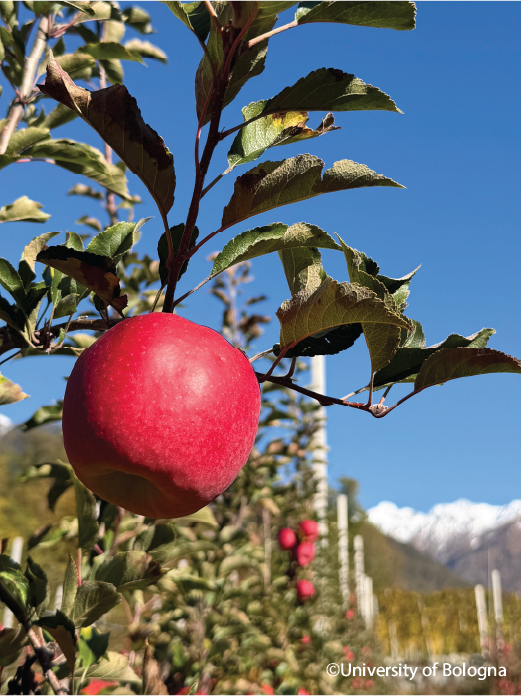
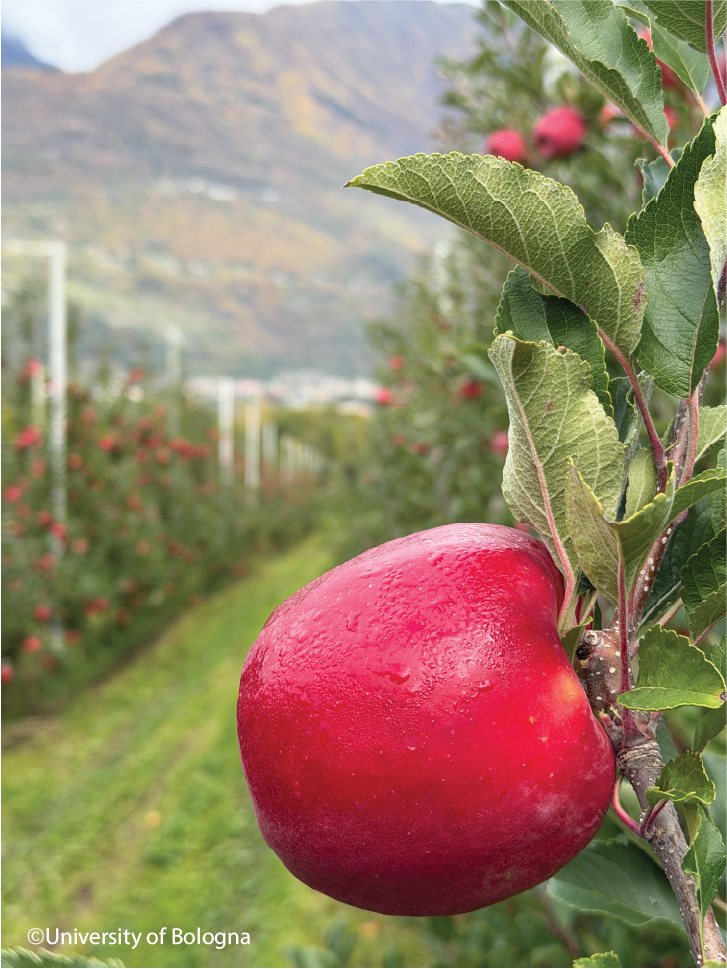
“The trials were intended to verify whether the variety expressed, in the pedo-climatic environment of Valtellina, the same agronomic and organoleptic characteristics observed in controlled environments — such as growth, yields, ripening patterns, storage capacity, pest resistance and response to treatments — as in the greenhouses and laboratories of the University of Bologna,” Biino explains.
For four years, productivity, fruit uniformity, trait stability, plant protection requirements and final quality were monitored. At the same time, another question emerged: is it possible to build a production and marketing value chain for a new apple in this territory?
When a Variety Becomes an Economic Project
A variety alone does not generate development. Without organisation of production, processing and sales, it remains confined to an experimental dimension.
As part of the economic assessments, qualitative and quantitative consumer market studies were also conducted to evaluate potential interest in a new apple — including preferred packaging formats, retail channels and possible combinations with other territory-linked products, Biino explains.
In parallel, work focused on the architecture of the value chain: identification of a managing entity, drafting of potential production and cultivation specifications, selection of an authorised nursery, creation of a network of potential growers, organisation of marketing, packaging and distribution, and definition of economic rules.
The name was chosen and the visual identity of the brand developed.
At this stage, Bernina© ceased to be simply a variety and became a structured project.
Exclusivity as a Territorial Choice
At the heart of the project was a clear decision: to link the new apple — later named and registered as Bernina© — to Valtellina.
“Lombardy aimed to relaunch the Valtellina apple sector by offering the possibility of an exclusive new apple,” explains Biino.
This exclusivity is regulated through the licence agreement signed with the managing entity, the Fojanini Foundation for Advanced Studies in Sondrio, and translates into concrete commitments, including minimum planting thresholds during the first four years and royalties payable to UNIBO-KTO as the breeder.
The guiding principle of the entire project was to build solid foundations within the territory, creating a network among producing farms, packaging and distribution companies, the Managing Entity and consumers, so that the value chain could grow and take root locally, generating new development opportunities for the sector and its wider ecosystem.
Protection as a Silent Infrastructure
In the Bernina© project, the variety is protected through a plant variety right and supported by a trademark that identifies the product on the market.
In practical terms, this means that the variety can only be cultivated according to defined rules, propagation of plant material is authorised, production is traceable and royalties are paid to the breeder.
These tools are not a legal detail: they constitute the silent infrastructure that makes the value chain possible. Without a clear framework of rights and authorisations, neither stable investments nor shared rules could exist.
The Role of the Public Body
ERSAF’s role was to design the pathway, manage the funds, prepare procurement procedures, coordinate different actors, verify that activities progressed as planned, monitor results and regularly liaise with the Region regarding ongoing actions.
This is a typical function of a public body when it operates effectively: creating the conditions that allow others to work.
A Project that Takes Climate Change into Account
In the background lies a broader dynamic. The climate change currently underway is already reshaping the geography of crops: vineyards moving to higher altitudes, crops shifting latitude, and new species becoming viable where they previously were not.
The adaptability of a crop to a specific territory always results from a combination of factors — climate, soil physico-chemical characteristics, irrigation water availability, topography — together with the capacity of the socio-economic fabric to enhance the productive value chain.
Bernina© fits within this scenario: testing whether a new variety can offer greater environmental sustainability and improved adaptability compared with traditional plantings.
Beyond Bernina©
In the end, Bernina© becomes something more than an apple.
It becomes a concrete example of how agricultural innovation requires much more than a good variety: it requires time, coordination, expertise and public responsibility.
A slow, technical and often discreet form of work.
But precisely the kind of work that allows innovation to last.